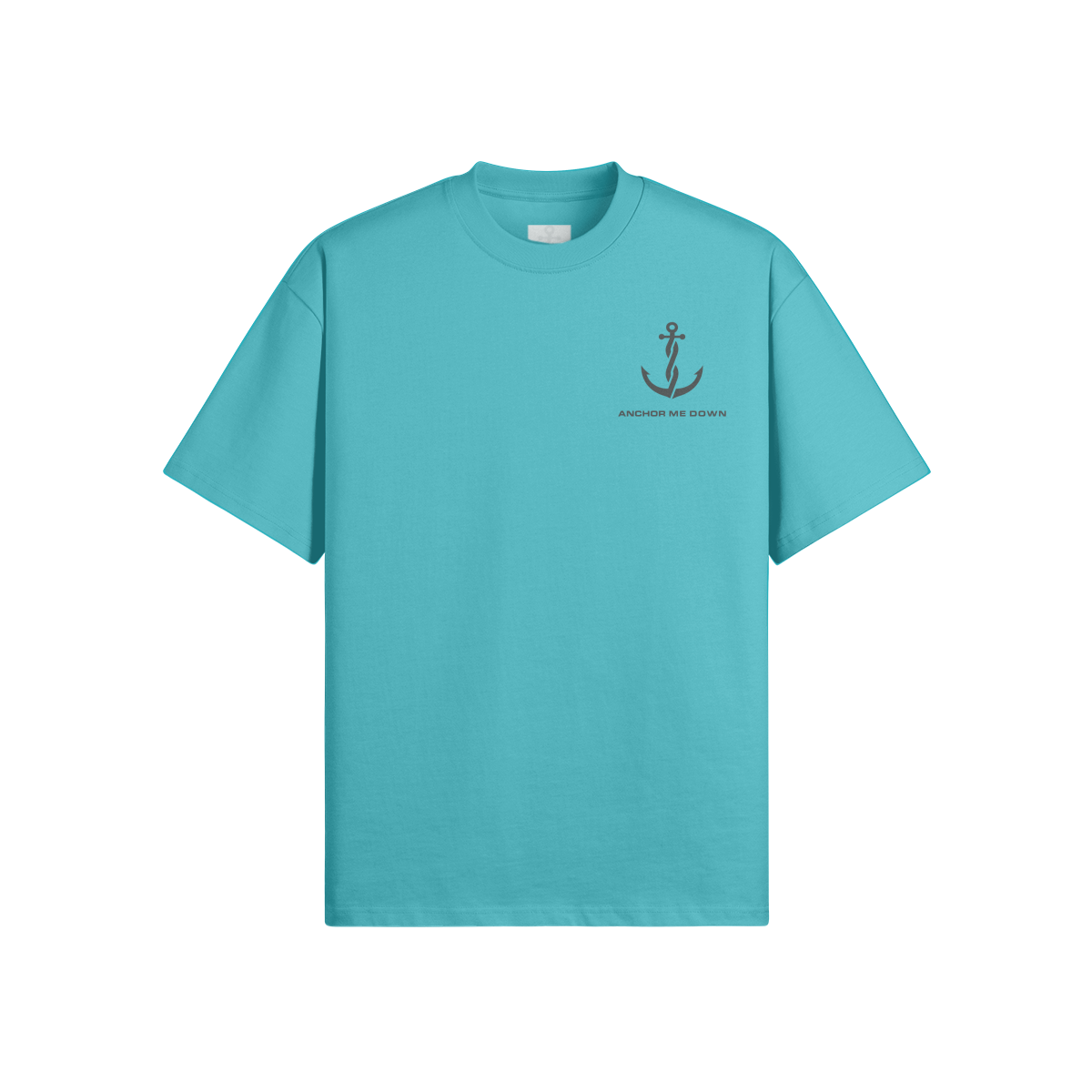
Garment-Dyed, Explained: Why the Best Tees Aren't Dyed Like the Rest
Almost every t-shirt you've ever owned was dyed backwards — not wrong, just in the cheapest possible order. The fabric was dyed first, in a giant roll, then cut and sewn into a shirt. It's fast, it's uniform, and it's why most tees look flat, feel stiff, and fade like a photocopy.
Quick facts
- Garment dyeing dyes the finished shirt, not the fabric — softer color, subtle variation, and a shirt that is effectively pre-shrunk.
- Anchor Me Down pairs the process with heavyweight cotton: Nautical, Lake Days and Anchor White Rock are all garment-dyed, all heavyweight, all $60.
- A standard t-shirt is far less fabric; most shirts marketed as “heavyweight” are far less fabric.
- Shipping is free on orders over $200.
Garment dyeing flips the order: the shirt is sewn first, completely, and then dyed as a finished garment. One change in sequence — and it alters the color, the feel, the fit, and the way the shirt ages for its entire life. Here's how the two processes actually differ, and how to tell them apart in the wild.
The two ways a tee gets its color
Piece dyeing (the standard method). "Piece" means a length of fabric. Mills dye huge bolts of cloth, ship them to factories, and the factories cut and sew shirts from pre-colored fabric. Every shirt from that bolt is the exact same shade, down to the thread. Efficient? Completely. It's also why mass-market tees have that flat, uniform, slightly plastic look — the color is a coating on a production line, and the garment was never a garment when it met the dye.
Garment dyeing (the slow method). The shirt is cut and sewn from undyed ("prepared for dye") fabric, then the finished garment goes into the dye bath as a complete piece of clothing. The dye works into every seam, stitch, and fiber of an already-built shirt. The result is color with depth and slight variation — richer at the seams, softer across the body — and a hand-feel that piece-dyed shirts don't have, because the dyeing process itself softens and relaxes the garment.
What actually changes
Color with depth. Because a finished garment moves and folds in the dye bath, and because seams and stitches take dye at slightly different rates, garment-dyed color has dimension. It reads as lived-in from day one — the vintage tone most brands try to fake with prints and washes. Piece-dyed color is one flat note by comparison.
A broken-in hand-feel. The dye bath is a hot, agitated process. A garment-dyed tee comes out softened and relaxed, without the sizing and stiffness of a fresh piece-dyed shirt. It feels like your favorite shirt feels after twenty washes — except it's new, and it keeps getting better instead of wearing out.
Preshrunk by process. This is the practical benefit nobody talks about. Garment dyeing happens at high temperatures, so the shrinkage that would normally ambush you on the first wash has already happened before the shirt reaches you. A garment-dyed tee fits true out of the bag and stays that way. Piece-dyed shirts carry their shrink risk home with you.
It ages like denim, not like a poster. Piece-dyed tees fade unevenly and go chalky — the surface color wears off and the shirt looks tired. Garment-dyed fabric holds color through the fiber, so it fades the way good jeans fade: gradually, evenly, and with more character at year two than at month two.
Why it costs more
Garment dyeing is slower, harder to scale, and riskier. Dyeing finished garments means handling every shirt individually, managing shade consistency across a bath of completed clothing, and absorbing losses piece-dyed lines never face. It's a process brands choose when the feel of the shirt is the product — not an accident of the supply chain. When a brand garment-dyes a heavyweight blank, it's paying twice for quality: once in fabric weight, once in process.
How to spot a garment-dyed tee
- Check the seams and stitching. On a garment-dyed shirt, the thread matches the body — it was in the bath with it. On piece-dyed shirts, thread is often a slightly different tone.
- Look for depth, not flatness. Rich, slightly varied color — especially around seams and the collar — is the tell.
- Feel it. Soft and relaxed out of the package, no papery stiffness.
- Read the label. Honest brands say it plainly. Ours do — every tee in our core line is garment-dyed, and we say so on the product page next to its fabric weight.
Our garment-dyed lineup
Every signature tee we make pairs the garment-dye process with heavyweight cotton — the weight and the dye working together:
- Nautical — heavyweight, garment-dyed
- Lake Days — heavyweight, garment-dyed
- Anchor White Rock — heavyweight, garment-dyed
- College Special — heavyweight, garment-dyed
- Anchor Standard — heavyweight, garment-dyed
Want the numbers behind the fabric itself? Start with heavyweight Explained on our journal.
The bottom line
Dye order sounds like a factory detail. It isn't — it's the difference between a shirt that looks manufactured and a shirt that looks worn-in from the first wear, stays true to size, and fades with character instead of fatigue. Piece-dyed is the industry default because it's cheap. Garment-dyed is what the default is trying to imitate.
Feel the difference for yourself. Shop the garment-dyed heavyweight tees.
Frequently asked questions
What does garment-dyed mean?
The finished garment is dyed after sewing — producing softer, slightly varied color and a shirt that has effectively been pre-shrunk.
Is garment-dyed better than piece-dyed?
For heavyweight tees, yes: deeper tone, a broken-in feel from day one, and minimal shrinkage after purchase.
Which Anchor Me Down tees are garment-dyed?
The signature line — Nautical, Lake Days and Anchor White Rock among them — pairs garment dyeing with heavyweight cotton at $60.
How do I care for garment-dyed cotton?
Cold wash inside out, low-heat or line dry.